

The 10 Best Massage Software Platforms for 2026: Complete Comparison Guide
Not all massage software is built for clinical practice. This guide compares the 10 best platforms for 2026 across online booking, SOAP notes, automated reminders, and billing tools, helping you find the right fit for your practice.
The right software handles the admin work so you can focus on delivering exceptional care.
Running a massage practice means juggling client bookings, session documentation, billing, and follow-up communications while delivering hands-on care. The wrong software turns every administrative task into a bottleneck. The right platform automates the process entirely.
That’s where purpose-built massage software makes the difference. A clinical-grade platform handles online scheduling, SOAP note charting, automated reminders, and payment processing without requiring you to piece together disconnected tools or hire extra administrative staff.
This guide walks through the 10 best massage software platforms available in 2026. Each platform is evaluated on booking functionality, clinical documentation tools, client management features, and scalability for growing practices.
The massage therapy industry is projected to reach $126.8 billion globally by 2035 (Grand View Research). Practices that invest in professional management systems now are positioning themselves to capture that growth while competitors struggle with spreadsheets and handwritten notes.
- Professional massage software pays for itself within weeks by reducing no-shows and eliminating manual scheduling overhead.
- Over 43% of massage appointments are now booked outside traditional business hours, making 24/7 online booking essential (AMTA).
- Digital SOAP notes protect your practice legally while cutting post-session documentation time by more than half.
- Platforms designed for clinical workflows include HIPAA-compliant data storage, intake forms, and compliance tools as standard features.
- Session packages and memberships generate predictable monthly revenue without requiring additional working hours.
- All-in-one platforms outperform stacked single-purpose apps by eliminating sync errors and reducing login friction.
- Why purpose-built massage software matters in 2026
- Online booking that runs 24/7 without phone tag
- No-show prevention through automated reminders
- Clinical documentation: SOAP notes and intake forms
- Building client retention through software-driven workflows
- The 10 best massage software platforms ranked
- Matching software to your specific practice model
- Migration guide: switching platforms without disruption
Why Purpose-Built Massage Software Matters in 2026
Massage therapists manage client intake, appointment scheduling, session notes, billing, and ongoing communication. That workload doesn’t fit inside a calendar app designed for hair salons or a generic appointment scheduler built for consultants.
Client expectations have shifted. In 2026, booking an appointment means pulling out a phone, selecting a time slot, and receiving an automated confirmation. If your booking process still requires a phone call during business hours, you’re already losing potential clients to practices that removed that friction three years ago.
Data security regulations have also tightened. Storing client health information in an unsecured spreadsheet or a note-taking app is a liability that could cost you your practice. Platforms built for therapeutic massage include encryption, automated backups, and secure cloud storage as core functionality, not optional add-ons.
The business case for professional software isn’t about luxury features. It’s about operating a legitimate practice that clients trust, that protects you from regulatory exposure, and that scales without requiring you to hire administrative support just to stay organized.
Online Booking That Runs 24/7 Without Phone Tag
An empty appointment slot represents revenue you can never recover. Online booking removes every obstacle between a potential client and a confirmed session. No voicemail, no email back-and-forth, no manual calendar updates that create double-booking conflicts.
Professional massage platforms offer real-time self-scheduling accessible from any device. Clients select their preferred therapist, treatment type, and session duration. The system locks the appointment in without requiring anyone on your team to touch it. When cancellations open slots, automated waitlists fill them before they go to waste.
Ruana’s booking system operates 24/7 directly from your website, social media profiles, or email signature. Every booking syncs to your practice calendar instantly. No double-bookings. No phone tag. Review Ruana’s online booking system for massage practices to see the full workflow.
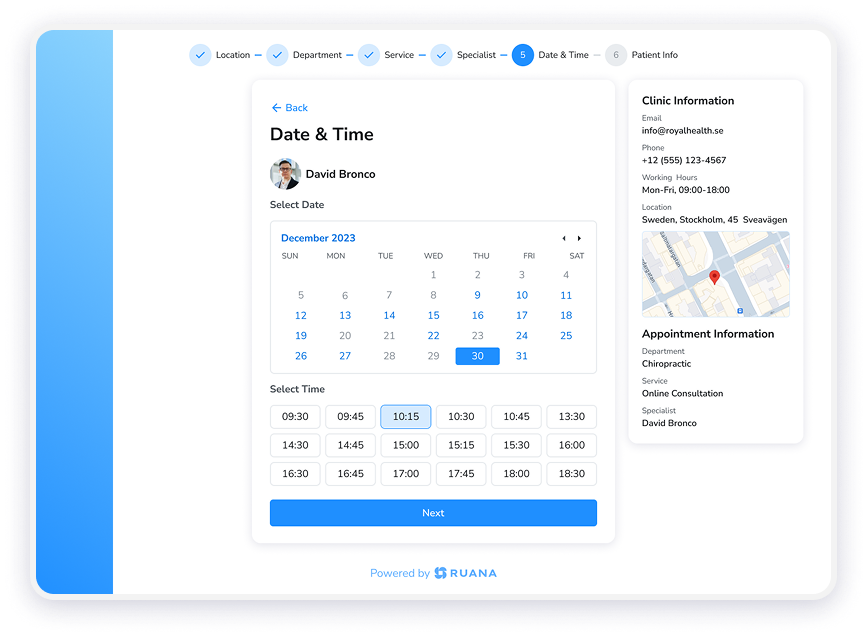
Ruana’s self-scheduling interface — clients complete booking in under two minutes.
No-Show Prevention Through Automated Reminders
A no-show doesn’t just cost you the session fee. It costs you the slot itself, the revenue someone else could have generated in that time, and the administrative effort spent chasing down the client afterward. No-shows are a systems failure that requires a systems solution.
Automated SMS and email reminders are the most effective intervention available. Industry research consistently shows that multi-step reminder sequences reduce missed appointments by more than 80%. The timing matters: a 48-hour advance reminder gives clients time to reschedule if conflicts arise, and a same-day message eliminates forgetfulness as a factor entirely.
Ruana sends automated SMS and email reminders on schedules you configure. Clients confirm or cancel directly from the message, updating your calendar automatically without requiring manual intervention. See how Ruana’s reminder system works for massage therapists.
Clinical Documentation: SOAP Notes and Intake Forms
Thorough session documentation is both a professional standard and a legal requirement in most jurisdictions. When you’re seeing six to eight clients daily, documentation that takes seven minutes per session adds up to nearly an hour of unpaid administrative work every day.
Purpose-built platforms include SOAP note templates designed specifically for massage therapy workflows. Subjective, Objective, Assessment, and Plan fields are pre-formatted for your modalities: Swedish, deep tissue, sports massage, prenatal, myofascial release, trigger point therapy. Staff complete notes faster, and documentation stays consistent across every therapist in your practice.
Digital intake forms are equally important. When clients complete health questionnaires, contraindication disclosures, and consent forms online before their first visit, you walk into the session fully informed. The paperwork is already stored in their file. Cloud storage with full encryption keeps everything accessible from any device while maintaining compliance with data protection regulations.
Ruana’s SOAP charting system includes ready-made massage therapy templates alongside a fully customizable chart builder. The Advanced SOAP Notes tier adds Automatic Notes functionality, allowing therapists to program one-click insertion buttons that drop complete treatment sentences and exam findings into notes instantly. Review Ruana’s SOAP notes and charting capabilities for full feature details.
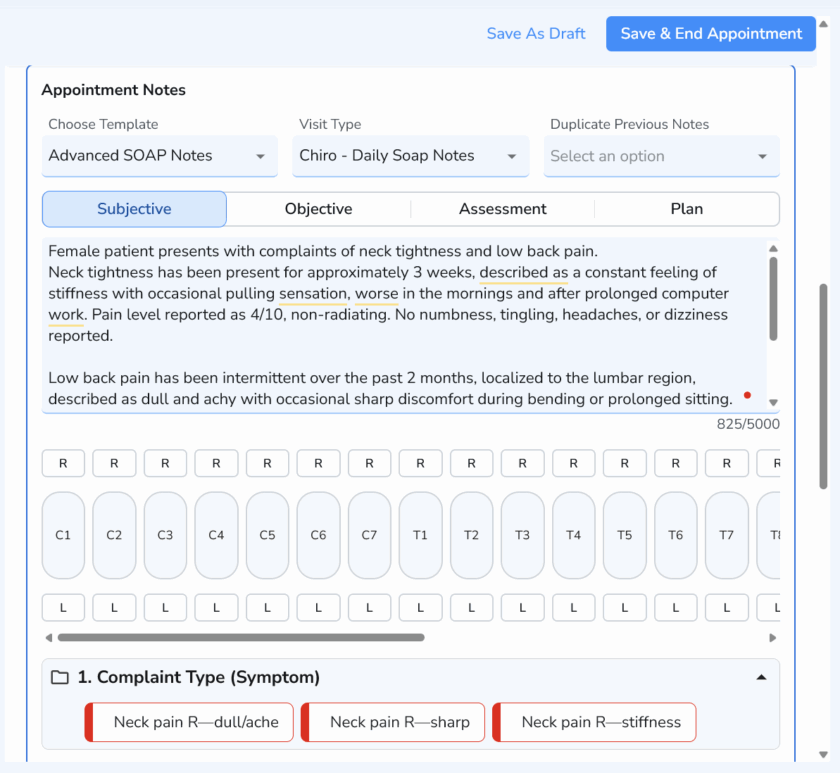
Ruana’s SOAP builder — complete comprehensive session notes in under three minutes.
Building Client Retention Through Software-Driven Workflows
A client who books a single session and never returns represents pure acquisition cost with zero long-term value capture. Practices that scale successfully are the ones that systematize retention rather than relying on sporadic follow-up efforts.
Software-driven retention operates on multiple levels. Session packages and memberships create commitment before the first appointment ends. A client who purchases a six-session package has already allocated budget for future visits. Monthly membership plans generate predictable recurring revenue that stabilizes baseline income regardless of seasonal booking fluctuations.
Ruana supports session packages with flexible session counts, memberships with defined billing cycles, and automated tracking that monitors remaining session credits and expiration dates. Every package purchase, membership renewal, and balance adjustment happens inside the same system managing your bookings and clinical documentation. For complete pricing and feature breakdowns, see Ruana’s packages and memberships functionality.
Complete Ruana platform walkthrough — booking, scheduling, SOAP notes, and billing in one workflow.
The 10 Best Massage Software Platforms Ranked
Not every platform on this list was originally designed for therapeutic massage practice. Some were built for fitness studios and added massage functionality later. Others were developed for medical practices and lack the scheduling flexibility independent practitioners need. The differences matter significantly when evaluating long-term fit.
1 Ruana — Best Complete Solution for Growing Massage Practices
What differentiates Ruana from competitors is that it was designed from day one for clinical workflows, not adapted from salon software or fitness studio platforms. The Automatic Notes feature, available in the Advanced SOAP Notes tier, allows therapists to pre-program insertion buttons that drop complete treatment descriptions into session notes with a single click. For practices seeing six clients daily, that functionality saves genuine time every single day.
Every plan includes free data import, a dedicated onboarding call, and ongoing support through live chat and email. No implementation fees. No hidden migration costs. Start a 14-day free trial with no credit card required.
2 Mindbody
3 ClinicSense
4 MassageBook
5 Fresha
6 Vagaro
7 Zenoti
8 Square Appointments
9 Schedulicity
10 Booker by Mindbody
Matching Software to Your Specific Practice Model
The optimal software for a solo mobile therapist is fundamentally different from what a four-room clinic with dedicated front desk staff requires. Purchase a platform designed for a different business model and you’ll pay monthly fees for features you never use, or worse, operate without the functionality you need daily.
Use the comparison table below to identify which features are essential for your specific practice setup and which platforms actually deliver them.
| Practice Type | Essential Features | Recommended Platforms |
|---|---|---|
| Solo Therapist | Online booking, SOAP notes, invoicing, client database | Ruana Solo, MassageBook |
| Multi-Therapist Clinic | Multi-staff scheduling, advanced reporting, SOAP notes, memberships | Ruana Professional, ClinicSense |
| Mobile Therapist | Mobile-optimized booking, travel time buffers, automated reminders | Ruana, MassageBook |
| Sports & Athletic Massage | Advanced SOAP notes, progress tracking, session packages | Ruana Professional, ClinicSense |
| Corporate On-Site Programs | Group booking, bulk scheduling, HR invoicing | Schedulicity, Ruana |
| Massage Franchise | Multi-location dashboards, centralized reporting, royalty tracking | Zenoti, Mindbody |
| Holistic Wellness Practices | Flexible intake forms, modality-specific SOAP templates, packages | Ruana, Vagaro |
| Spa + Retail Operations | Point-of-sale, product inventory, booking, loyalty programs | Booker, Vagaro |
If your practice operates as a solo therapist or multi-therapist clinic, which accounts for the majority of independent massage businesses, Ruana’s massage therapy platform was designed specifically for your workflow, with pricing that scales from your first client to a full multi-room operation.
Migration Guide: Switching Platforms Without Disruption
The primary reason massage therapists remain on inadequate software is fear of operational disruption during migration. The transition does represent a significant project. But it’s a contained project with a clear completion point, not an ongoing source of friction like using the wrong platform every single day for years.
Successful migrations start with data integrity. Your client profiles, appointment history, and clinical records must transfer cleanly to the new system. Any platform worth serious consideration offers complimentary data import services. If a platform charges for migration or doesn’t support data import at all, eliminate it from consideration immediately.
A real onboarding call matters as much as the data transfer itself. You should complete that call with your booking page live, your SOAP templates configured for your specific modalities, your reminder schedules active, and a clear understanding of how billing and reporting tools function. Generic tutorial videos and documentation cannot replace a direct conversation about your specific operational workflow.
The cleanest migration approach: operate both systems in parallel for one to two weeks. Route all new bookings through the new platform while completing existing committed appointments in your old system. By the time those legacy appointments conclude, you’re fully transitioned without any service gaps or client confusion.
Ruana includes complimentary data import and a personalized setup call at every subscription tier. No additional fees. No technical expertise required from your team. Schedule a live Ruana demo or onboarding call to see the platform configured for your specific practice before making any commitment.
Massage Software: Implementation Checklist
- Identify your practice model before evaluating platforms. Solo, multi-therapist, mobile, and corporate operations each require different core functionality.
- Implement online booking before any other features. With 43% of appointments now booked outside business hours, every day without self-scheduling represents lost revenue.
- Configure automated reminders immediately. A two-step sequence with 48-hour advance notice and same-day confirmation reduces no-shows by more than 80% within the first month.
- Select platforms with SOAP note templates designed explicitly for massage therapy modalities, not generic medical forms repurposed from billing software.
- Launch at least one session package or membership option within 60 days of platform implementation. Recurring revenue stabilizes cash flow faster than any marketing initiative.
- Verify that data migration is complimentary and that dedicated onboarding support is included before finalizing any purchase decision.
- Confirm client health data is stored on encrypted cloud infrastructure with automated backups. Local storage and unsecured systems represent genuine legal liability under current data privacy regulations.
- Review financial reporting dashboards monthly. Appointment volume trends, revenue by service type, and client visit frequency are the three metrics that indicate whether your practice is actually growing or plateauing.
See the complete Ruana platform in action before committing to anything. Watch the full feature walkthrough, then start your risk-free trial.
No credit card required. Complete setup in under 15 minutes.